Trauma Scene
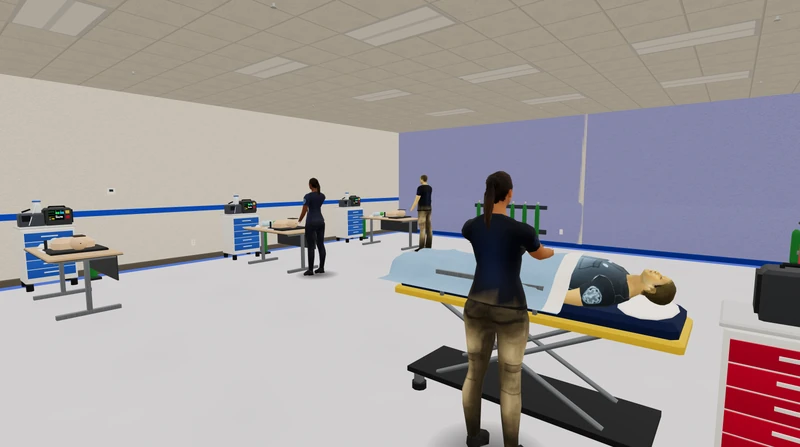
A full-size trauma scene for EMT, AEMT and Paramedic students to work from first contact to packaging.
- Mock accident victim with bleeding control and airway problems.
- Bystanders and scene hazards to manage.
 STC ACADEMYSIMULATION TRAINING CENTER

Built for the EMT-B to Paramedic path.
Students start with EMT-B, and their badge unlocks more of the building as they advance: skills labs, three scenario rooms and a Stress Chamber.
Also trains in the Hospital Sim Wing, a shared training section of the building.
The EMS program lives in the EMS Wing. It trains Emergency Medical Technicians, Advanced EMTs and Paramedics in classrooms, skills labs and timed scenarios, with proctored exams followed by video playback to learn from.
Every EMS student also trains in the Hospital Sim Wing and the EVOC Course.
Pulled from the classrooms, labs and scenario files in the Emergency Medical Services plan.
Every room below is in the 3D building and on the floor plans. See the full EMS wing.
A full-size trauma scene for EMT, AEMT and Paramedic students to work from first contact to packaging.
A home-style scene for cardiac emergencies.
A pediatric emergency scene built around a child patient and a worried family.
One lab for airway management and cardiac care.
Bleeding control, splinting and IV access, practiced station by station.
A closed room that turns up the noise, light and pressure so skills hold up under stress.
Where instructors build and stage each scenario before students walk in.
Instructors watch the scenario rooms and steer each call as it unfolds.
Two debrief rooms where crews replay the call right after it ends.
A larger debrief room for calls that EMS and fire crews worked together.
Home base for EMT students.
The step up from EMT.
Advanced coursework for paramedic students.
Advanced life support for adults, children and infants.
Communication and crew leadership.
Three levels inside EMS. Paramedic requires EMT-B; AEMT is optional. Each level has its own classroom, instructor, students, labs and skills sign-off, and the badge unlocks more of the building as you go.
Provides foundational instruction for Emergency Medical Technician students.
Focus: Basic life support, patient assessment, and emergency response.
EMT-B badge: EMS Wing, EVOC Course, Hospital Sim Wing.
Apply for EMT-B →Provides advanced instruction for Advanced Emergency Medical Technician students.
Focus: IV therapy, advanced airway management, and pharmacology.
AEMT badge adds advanced skills lab time.
Apply for AEMT →Provides specialized instruction for Paramedic students.
Focus: Advanced patient care, cardiac life support, and trauma management.
Paramedic badge adds Paramedic labs and joint exercises in the Fire/Rescue wing.
Apply for Paramedic →Certification is tied to both skill and conduct. Exams and practice exams (including paramedic board practice) are taken in the Testing Center on Level 3.
A typical day, built from the rooms and scenarios on campus.
From his Career Pathways file: training is linked to certification and advancement, with a clear progression from student to professional, and it tracks readiness for EMT-B and paramedic roles.
Ambulance and rescue squad crews
IV and advanced airway care in the field
Advanced life support and critical transport
Air medical and interfacility transport
Hospital emergency departments
Many medics go on to RN, PA or MD programs
Admissions & Registration verifies identity, transcripts, and prerequisite requirements.
The application takes about 10 minutes and saves as you go. EMS will already be chosen for you.


