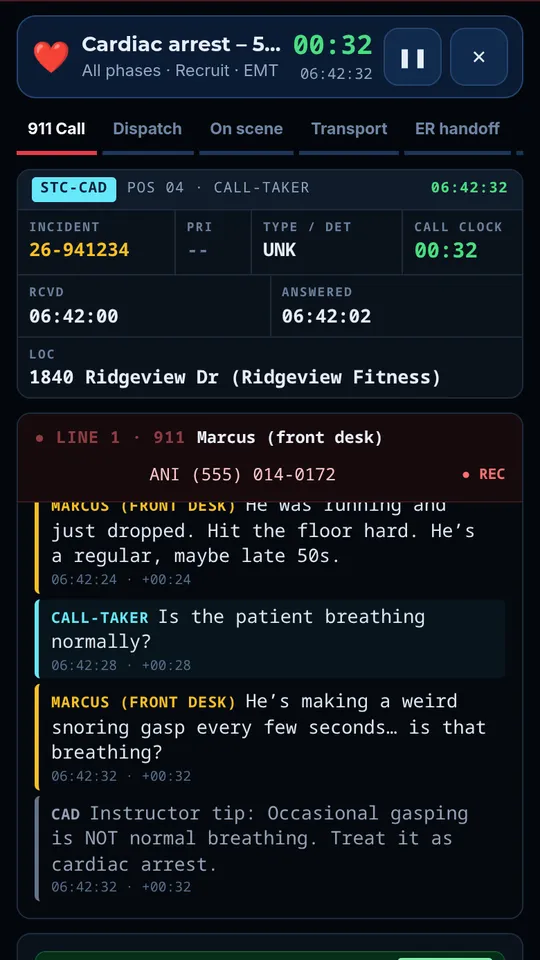
Run a 911 call from the first ring to the ER.
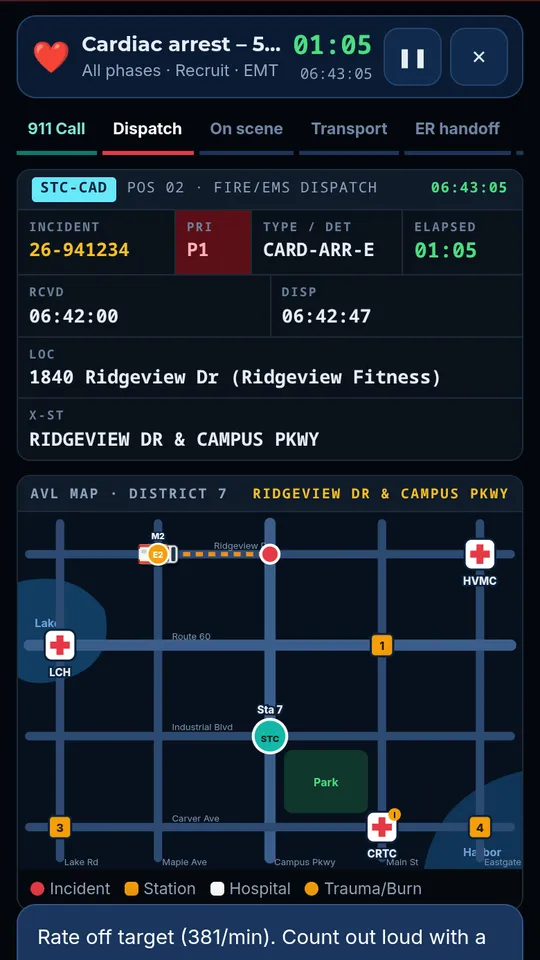
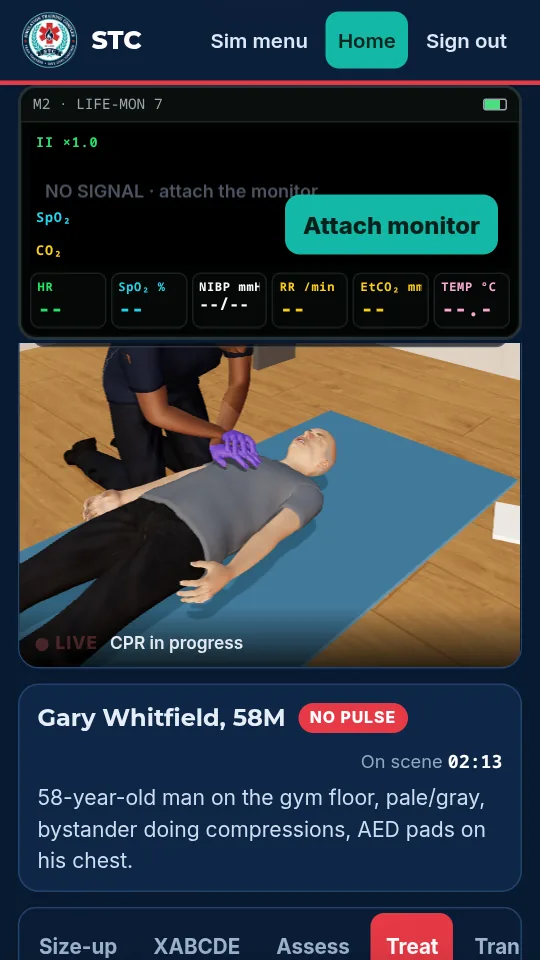
Take the call, send units on a live CAD map, treat the patient on scene with skills tagged EMT-B, AEMT or Paramedic, then radio the hospital and hand off. Every decision is timed, scored and explained in your debrief.
- 📞 911 call
- 🗺️ Dispatch
- 🚑 Scene
- 💉 Treatment
- 🏥 Hospital
- 📊 Debrief
One full call is open to everyone. Training simulation, not medical advice.
How a call plays
Right in your browser, on a phone or a computer. No download.
What's inside
- The whole chain of careEvery call runs from the 911 line to the ER handoff, not just one piece.
- Skills tagged by levelSkills tagged EMT-B, AEMT or Paramedic. Assess, manage the airway, control bleeding and give medications within your scope.
- Live patientsVitals and the monitor respond to your treatment, or to the lack of it.
- Different callsCardiac arrest, trauma, breathing, stroke, burns and more.
- Three ways to playDispatcher, Medic, or Both, at three difficulty levels.
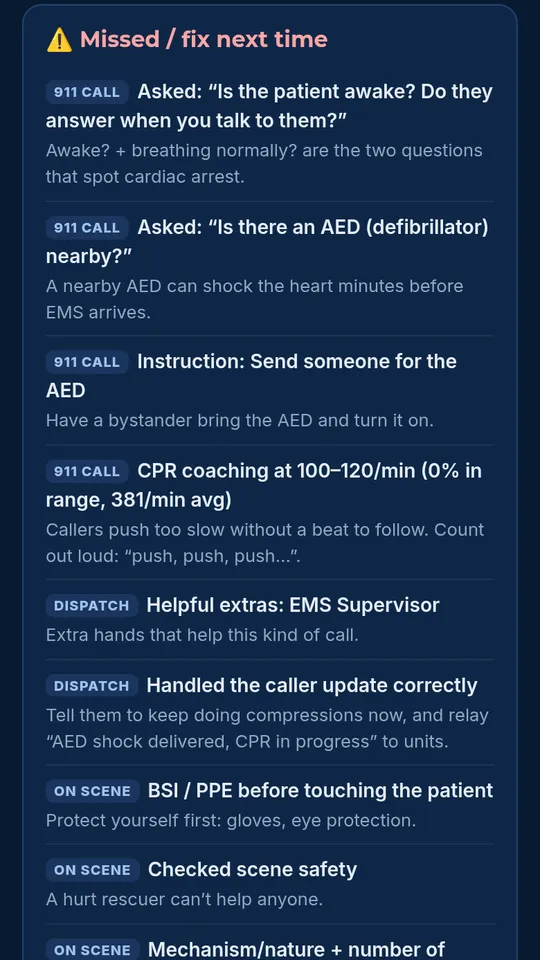
- A real debriefA grade, what you did right and the misses to work on.
Skills by level
Every skill in the sim is tagged with its level. Choose your scope before a call and skills above it are locked.
CPR and AED, bag-valve-mask, oxygen, airway adjuncts, CPAP, bleeding control and tourniquets, splints, spinal motion restriction, naloxone, epinephrine auto-injector, oral glucose, aspirin and albuterol.
IV and IO access, IV fluids, IV dextrose, glucagon, supraglottic airway and IV/IO epinephrine in cardiac arrest.
Endotracheal intubation, amiodarone, magnesium, steroids, pain medication, anti-nausea and seizure medication, and IV blood pressure medication.
See every skill and its level
- Attach monitor (ECG, SpO₂, BP cuff)
- Full set of vitals
- SAMPLE history
- Listen to lung sounds
- Check blood glucose
- 12-lead ECG
- BE-FAST stroke check
- Confirm last-known-well time
- Stroke severity (LVO) screen
- Rapid head-to-toe trauma exam
- Pediatric Assessment Triangle
- CO-oximetry (SpCO)
- Estimate burn size (rule of nines)
- Open airway (head-tilt / jaw-thrust)
- Suction the airway
- Oral airway (OPA)
- Nasal airway (NPA)
- Bag-valve-mask ventilation with O₂
- Oxygen · nasal cannula 2–6 L
- Oxygen · non-rebreather 15 L
- Recovery (side) position
- Position of comfort / head up
- CPAP
- High-quality CPR · 2-minute cycle
- Analyze rhythm / shock (AED/monitor)
- Tourniquet
- Direct pressure / pack wound
- Pelvic binder
- Keep warm (blankets, heat up the box)
- Aspirin 324 mg chewed
- Nitroglycerin (assist)
- Oral glucose
- Naloxone (intranasal)
- Albuterol nebulizer (per protocol)
- Epinephrine IM (auto-injector)
- Ipratropium with albuterol
- Spinal motion restriction
- Splint extremity
- Occlusive chest seal
- Cool burns with clean water (briefly)
- Apply ice packs to burns
- Dry sterile dressings / burn sheet
- Remove rings, watch, jewelry
- Check temperature
- Check distal pulse, motor, sensation (PMS)
- Newborn APGAR score
- Postpartum check (bleeding + fundus)
- Back blows + abdominal thrusts (choking)
- Look in the mouth, remove a visible object
- Protect from injury, time the seizure
- Hold the patient down
- Put a bite block in the mouth
- Open OB kit, prepare for delivery
- Support the delivery (control the head)
- Newborn: dry, warm, stimulate, position airway
- Clamp and cut the umbilical cord
- Deliver the placenta (no pulling), bag it
- Fundal massage + baby to breast
- Traction splint
- Move with a scoop stretcher / vacuum mattress
- Move to a cool spot, remove gear / extra clothing
- Cold-water immersion · 3 minutes
- Ice packs to neck, armpits, groin + wet towels, fan
- Supraglottic airway (i-gel style)
- IV / IO access
- Fluid bolus (small, titrated)
- Dextrose IV
- Epinephrine IV/IO (cardiac arrest)
- Glucagon IM
- Endotracheal intubation
- Magnesium sulfate IV
- Dexamethasone (steroid)
- Amiodarone IV/IO (refractory VF)
- Fentanyl for pain
- Ondansetron (nausea)
- Lower BP with IV medication
- Diphenhydramine (antihistamine)
- Midazolam (stops a seizure)
Levels follow the US National EMS Scope of Practice Model. Your state and agency protocols decide what you may do.
Every call
The cardiac arrest call is open to everyone. Every other call opens with an STC sign-in.
Questions about access? Contact STC.
Training a class, squad or hospital team? See For Institutions.
Questions
Does this give CE credit or a certification?
No. STC is a training simulation. It does not give CE credit, and it is not a certification or a school course.
Is this medical advice?
No. Training simulation, not medical advice. Always follow your agency's protocols and medical direction. Every patient, place and phone number in the sim is fictional.
Can I try it first?
Yes. The cardiac arrest call is open to everyone as a preview, from the 911 call to the debrief. Try it now.
I lost my access code.
Email jaylen@stc-academy.org and you'll get a new one. The old code stops working.
Who makes STC?
STC is a concept project by Jaylen Thomas. Questions go to Contact.
Ready to take the call?